
Citizens of Uganda are required to obtain a visa in order to enter Jordan.
This means that Ugandan travelers must complete the necessary application process and meet the requirements set by Jordanian authorities before being granted permission to visit the country.
Depending on your situation, you have three main options: an Electronic Visa (eVisa), a Visa on Arrival, or a Regular Visa obtained through a Jordanian Embassy or Consulate. Each option has different requirements and processes.
Additionally, travelers from Uganda may be asked to provide other documents to enter Jordan, for example, a passport that doesn’t expire for 6 months from the intended trip date.
Types of Jordan Visas for Ugandan Citizens
Ugandan citizens visiting Jordan have several visa options to consider, depending on the purpose and duration of their stay.
Each Jordan visa type comes with its own set of conditions, so it is essential to choose the one that best fits your travel plans.
Electronic Visa (eVisa)
The Jordan eVisa is an online visa that allows Ugandan citizens to enter Jordan without visiting an embassy. However, not all Ugandan passport holders qualify for this option.
Eligibility: Ugandan citizens can obtain a Jordan eVisa if they hold a valid residence visa from a Gulf Cooperation Council country, or have a valid visa or permanent residence from Australia, Canada, USA, UK, Japan, South Korea, or any European country (including Schengen visas).
Jordan offers several types of eVisas:
- Visit Visa: For tourism, family visits, or business purposes
- Transit Visa: For travelers passing through Jordan to another destination
- Exit/Entry Visa: For residents of Jordan who need to leave and return
- Study Visa: For students enrolled in Jordanian educational institutions
- Work Visa: For individuals with employment in Jordan
Most Ugandan tourists apply for the Visit Visa, which is the standard option for short stays.
Visa on Arrival
Ugandan citizens can obtain a Visa on Arrival at Queen Alia International Airport or other entry points in Jordan, but only under specific conditions.
Eligibility: Similar to the eVisa, Ugandan passport holders must have a valid GCC residence visa, Schengen visa, US visa, or permanent residence in Australia, Canada, USA, UK, Japan, South Korea, or any European country.
Regular (Consular) Visa
If you do not meet the requirements for an eVisa or Visa on Arrival, you must apply for a Regular Visa through a Jordanian Embassy or Consulate.
This process requires submitting documents in person or by mail and waiting for approval before traveling.
Jordan Pass
The Jordan Pass is an all-in-one tourist package that combines your single-entry visa with prepaid access to over 40 major attractions, including Petra and Jerash.

Purchasing the pass online before your trip can be a great way to save money. If your stay in Jordan is 3 nights or longer, the visa fee is completely waived.
There are three types of passes available, priced between 70 and 80 JOD (around $99-$113 USD), with the main difference being the number of days you’re allowed to explore Petra.
At the moment, the Jordan Pass is restricted to Ugandan passport holders, but you can still obtain it if you have a citizenship of an eligible country.
IMPORTANT: The Jordan Pass does not replace visa requirements. Ugandan citizens still need to meet the eligibility criteria for entering Jordan, but the pass waives the visa fee if they stay long enough.
Documents to Apply for a Jordan Visa
The exact documents Ugandan nationals need to prepare will depend on the specific type of Jordanian visa they are applying for, as each has its own set of requirements.
Below is a general list:
- Ugandan passport (minimum 6 months validity)
- Recent face photograph
- Proof of qualifying visa or residence permit for eVisa/VoA (GCC residence visa, Schengen visa, US visa, or permanent residence in Australia, Canada, USA, UK, Japan, South Korea, or any European country)
- Proof of accommodation in Jordan
- Return flight ticket
Depending on your travel purpose, you might need to provide extra documentation.
For example, if you’re a Ugandan citizen visiting Jordan for work, you may need to provide a letter of invitation from a Jordanian company. Similarly, those planning to study in Jordan will likely need to submit an acceptance letter from their educational institution.
Always check with the relevant Jordanian authorities or official embassy websites to ensure compliance with the latest visa requirements.
Jordan Visa Application Process
Applying for a visa to Jordan involves several important steps and requires careful attention to detail.
The process may vary depending on the type of visa Uganda passport holders need, such as an eVisa, a VoA, or a Regular Visa.
It is essential to gather all the necessary documents in advance to avoid delays or complications during your application.
Applying for an eVisa
Understanding the specific procedure for a Jordan eVisa will provide a smoother experience and increase the chances of approval.
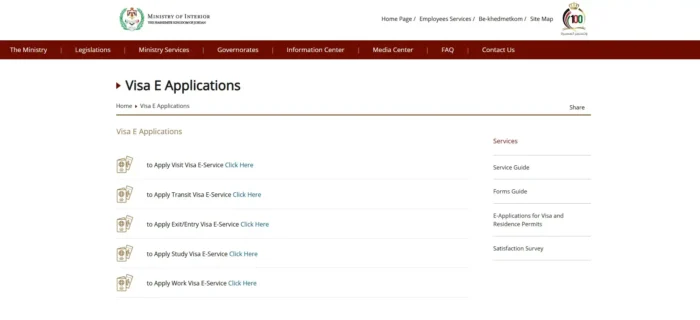
- Go to the official Jordan eVisa website: Select the type of visa you need and click the correct link.
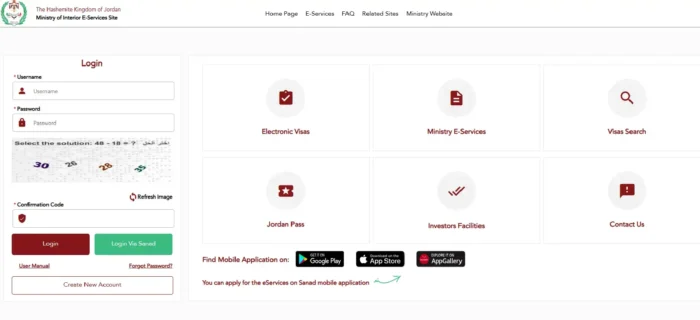
- Log in or register: Log in to your account and enter the verification code. If you don’t have an account, you’ll need to create one first.
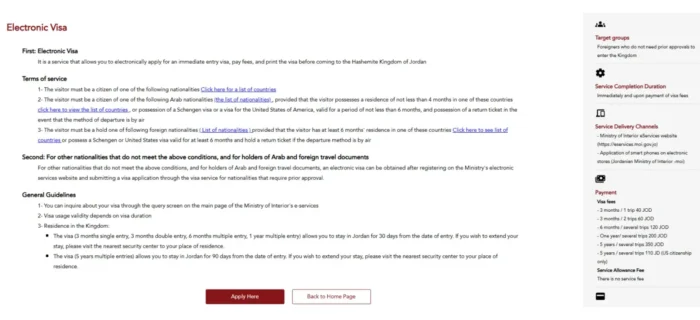
- Read the guidelines: Carefully read the terms and general guidelines, then select “Apply Here.”
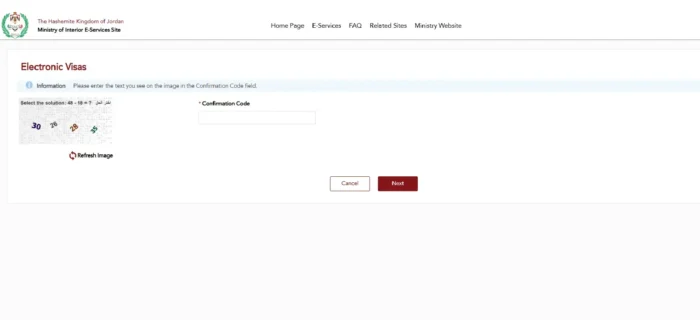
- Enter the confirmation code: Type the code shown in the image and click “Next.”
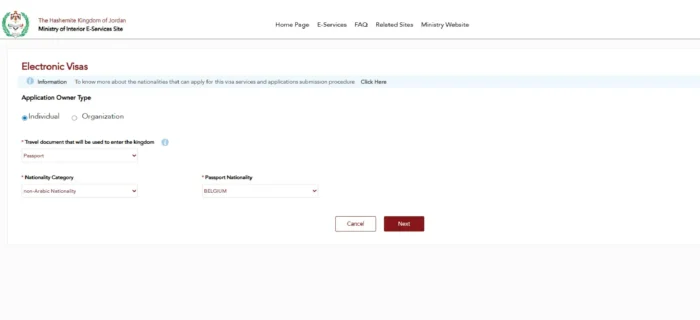
- Provide application details: Specify if you are applying as an individual or an organization. Then, select your travel document type, nationality category, and passport nationality.
- Enter your personal and visa details: Select the correct visa type and enter your full name, date of birth, and passport details.
- Add your contact information: Provide your address in Jordan, email, and phone number. Review and accept the terms and conditions.
- Verify your email: Enter the verification code sent to your email to confirm your application.
- Pay the fee: Complete the payment using a credit or debit card.
- Submit your application: Review all the information you’ve entered, then click “Submit.”
Ugandan nationals can track the status of their Jordan eVisa anytime by logging into their portal account. The status will show whether the application is pending, approved, or needs action.
Once approved, the Electronic Visa will be sent to you via email as a PDF. Make sure to print it and carry it with you for travel and immigration control.
Applying for a Visa on Arrival
To enter Jordan, Ugandan citizens should start by arriving at Queen Alia International Airport or another designated entry point.
Before proceeding to immigration, visit the visa desk where you will need to present your Ugandan passport along with a qualifying visa or residence permit.
Additionally, provide proof of accommodation and a return flight. Once these documents are verified, pay the visa fee of 40 Jordanian Dinars to receive your visa stamp.
After obtaining your visa, proceed to immigration. Make sure all your documents are prepared in advance to avoid any delays.
Applying for a Regular (Consular) Visa
To apply for a Regular Visa to Jordan, Ugandan travelers should follow these steps carefully:
- Locate the nearest Jordanian Embassy or Consulate.
- Download and complete the visa form.
- Gather all required documents.
- Schedule an appointment (if required).
- Submit your application in person or by mail.
- Wait for the processing.
- Collect your visa (if approved).
- Proceed to immigration.
The process and requirements for applying for a Jordan Regular Visa may vary depending on the country you are applying from. Some diplomatic missions may require an interview or additional documentation.
It is recommended to check with the nearest Jordanian Embassy or Consulate for specific instructions and updated information.
Stay, Validity, and Extensions
The Jordan eVisa offers Ugandan visitors several options: 3-month single-entry, 3-month double-entry, 6-month multiple-entry, and 1-year multiple-entry. A 5-year multiple-entry visa is also available, allowing for a 90-day stay per entry.
Typically, the Visa on Arrival is granted for a duration of 30 days, allowing travelers from Uganda to stay in the country for up to a month.
The validity of a Regular Visa depends on the visa type and purpose of travel. Tourist Visas are typically valid for 30 days, with extensions possible for certain visa types.
To extend your stay, visit the nearest police station in Jordan before your visa expires. Bring your passport, proof of accommodation, and a valid reason for extension. Overstaying your visa may result in fines or other penalties.
Jordan Visa Processing Time
An Electronic Visa to Jordan is usually processed within 72 hours (3 business days), so it’s recommended to apply at least one week before your travel date to allow extra time.
A Visa on Arrival is processed immediately at the airport, but waiting times can vary depending on the number of travelers.
A Regular Visa typically takes 5-10 business days to process at most Jordanian Embassies, so it’s best to submit the documents at least 2 to 3 weeks before your planned departure.
Jordan Entry Requirements
Ugandan citizens are required to meet certain Jordan entry requirements in addition to holding a valid visa.
These rules are essential for a successful entry process, and travelers from Uganda should be fully prepared before their journey:
- Passport: Its validity must be at least 6 months beyond your planned departure date from Jordan
- Return ticket: Visitors may need to show proof of onward or return travel
- Accommodation proof: Hotel reservation or invitation letter from a host in Jordan may be requested.
- HIV test: If staying in Jordan for more than 30 days, it is necessary to undergo a test as part of the entry requirements.
- Drone approval: If a Ugandan national plans to bring a drone into Jordan, they must apply for approval at least 10 working days before their travel.
Some airlines may ask to see these documents before allowing you to board your flight.
For stays in Jordan for more than 14 days, visiting the nearest residency extension office at the local police station is mandatory.
Moreover, a departure tax of 10 Jordanian dinars must be paid in cash at all land border crossings.
Jordan Embassy for Ugandan Citizens
The Jordan Embassy plays a critical role for Ugandan citizens applying for visas. It serves as the primary point of contact for obtaining detailed information about visa requirements, application procedures, and necessary documentation.
The embassy ensures that visitors meet all legal and procedural standards before traveling to Jordan, reducing the probability of complications during their trip.
Jordan does not have an embassy in Uganda, so its citizens contact the nearest Jordanian Embassy or Consulate in another country.
The details of the Jordan Embassy in Kenya:
- Address: POBox (37554-00100), 175 Ruaka Drive, Runda, Nairobi
- Phone: 00254796722266
- Email: Nairobi@fm.gov.jo
Frequently Asked Questions about Jordan Visas for Ugandan Citizens
- Do Ugandan citizens need a visa to enter Jordan?
Yes, Ugandan citizens are required to obtain a visa to enter Jordan. They can apply for an Electronic Visa (eVisa), a Visa on Arrival, or a Regular Visa depending on their eligibility and travel purpose. - What are the eligibility requirements for a Jordan eVisa for Ugandan travelers?
Ugandan citizens are eligible for a Jordan eVisa if they hold a valid residence visa from a GCC country, or if they have a valid visa/permanent residence in Australia, Canada, the USA, the UK, Japan, South Korea, or a European/Schengen country. - What is the processing time for a Jordan eVisa?
The processing time for an eVisa is typically 72 hours (3 business days). It is recommended to apply at least one week before the travel date to allow for possible delays. - Can Ugandan travelers get a Visa on Arrival in Jordan?
Yes, Ugandan citizens can obtain a Visa on Arrival at Queen Alia International Airport or other entry points, provided they meet specific eligibility criteria, such as holding a valid visa or residency from GCC or certain other countries. - What documents are required to apply for a Jordan visa?
Ugandan travelers typically need a valid passport (with at least 6 months’ validity), a recent photograph, proof of eligibility (such as a qualifying visa or residence permit), proof of accommodation, and a return flight ticket. - What is the validity of visas for Ugandan visitors to Jordan?
The Jordan eVisa allows options such as 3-month single-entry, 6-month multiple-entry, or 1-year multiple-entry. A VoA typically allows a stay of up to 30 days. Regular Visas may vary in validity depending on their type and purpose.
Conclusion
Ugandan citizens have several options for obtaining a Jordan visa, depending on their circumstances.
If you hold a valid GCC residence visa, Schengen visa, US visa, or permanent residence in select countries, you can apply for an eVisa or get a Visa on Arrival.
Otherwise, you will need to visit a Jordanian Embassy or Consulate to obtain a Regular Visa.
Make sure your passport is valid for at least 6 months, gather all required documents, and submit the application well before your travel date.
Sources
- https://moi.gov.jo/EN/Pages/Visa_E_Applications
- https://jordan.gov.jo/EN/Pages/Travel_Visas
- https://www.jordanpass.jo/
March 2026 Updates
As of March 2026, Ugandan citizens are required to obtain a Jordan visa through a Jordanian Embassy or Consulate. Ugandan passport holders should verify their current eligibility for eVisa or visa on arrival at the Jordan MoI portal at eservices.moi.gov.jo/MOI_EVISA/ or contact the nearest Jordanian embassy before travel. Required documents typically include a valid passport (6+ months validity, 2 blank pages), completed visa application form, passport-size photographs, proof of accommodation, return flight ticket, bank statements, and travel insurance. Processing times at the embassy typically range from 5–15 working days.
Last verified and updated: March 9, 2026